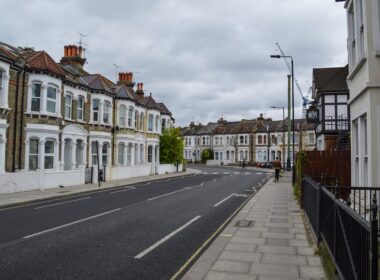


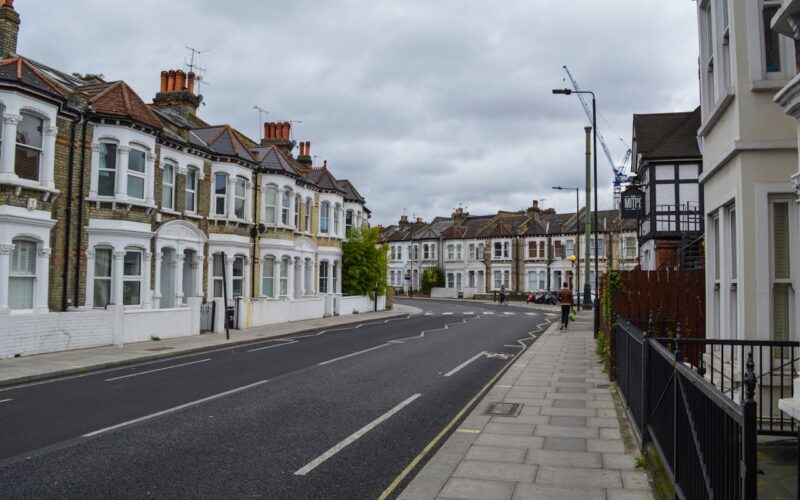
Homes in Islington are more than four times more likely to suffer subsidence damage than homes in Hillingdon when the next heatwave hits, according to a new analysis of London’s clay belt.
The borough-level ranking, produced by structural movement specialists Crackmonitors.co.uk, combines British Geological Survey clay exposure data, official street tree counts and Valuation Office Agency housing age records. It estimates that 8,050 London homes filed subsidence claims during the record 40.3°C summer of 2022, with insurers paying out around £77 million across the capital alone. With the ABI confirming a record £307 million in national subsidence payouts in 2025, the underlying risk is not going away.
The London Subsidence Vulnerability Index
The Index scores boroughs from 0 to 100 across three causal drivers: street tree density (weighted at 40%), London Clay exposure (35%), and the proportion of pre-1919 housing stock (25%). Trees draw moisture from clay soils as they dry, clay shrinks when it loses water, and Victorian and Edwardian homes were typically built with shallow foundations that struggle to absorb the resulting movement.
The 10 most vulnerable boroughs:
| Rank | Borough | Trees per km² | LSVI score | Estimated claims | Per 1,000 homes | Estimated payout |
|---|---|---|---|---|---|---|
| 1 | Islington | 702 | 93.4 | 367 | 3.71 | £3.5m |
| 2 | Kensington and Chelsea | 538 | 90.6 | 263 | 3.60 | £2.5m |
| 3 | Hammersmith and Fulham | 533 | 86.9 | 269 | 3.45 | £2.6m |
| 4 | Hackney | 500 | 79.6 | 345 | 3.17 | £3.3m |
| 5 | Haringey | 389 | 78.0 | 338 | 3.10 | £3.2m |
| 6 | Camden | 380 | 75.8 | 301 | 3.01 | £2.9m |
| 7 | Westminster | 375 | 73.7 | 322 | 2.93 | £3.1m |
| 8 | Waltham Forest | 516 | 71.7 | 310 | 2.84 | £3.0m |
| 9 | Southwark | 571 | 70.5 | 375 | 2.80 | £3.6m |
| 10 | Newham | 485 | 68.7 | 320 | 2.74 | £3.1m |
At the bottom of the table, Hillingdon scored 23.0, sitting on Thames gravel terraces with the second lowest tree density in the capital.
Why Islington tops the table
Islington has the highest concentration of street trees in London at 702 per square kilometre, sits almost entirely on the London Clay outcrop, and has roughly 48% of its housing stock dating from before 1919. Kensington and Chelsea sits second on the strength of England’s highest pre-1919 housing share at 65.1%. Hammersmith and Fulham, Hackney and Haringey complete a tightly clustered top five, all on London Clay with significant Victorian and Edwardian terraced stock.
Southwark recorded the highest absolute number of estimated claims at 375, lifted by the combination of dense tree cover, partial clay exposure and around 134,000 dwellings.
A north of the river problem, mostly
Boroughs north of the Thames account for roughly 65% of all estimated subsidence claims in a heatwave year, despite holding closer to 60% of the capital’s housing stock. The London Clay Formation, which underlies most of central and north London, is the dominant cause. South of the river, terrace gravels and chalk reduce risk, although Lewisham and Bexley remain in the upper half of the table.
The tree factor cuts across geology. In Sutton, which sits on chalk and gravels, street trees alone account for around 57% of the borough’s vulnerability score. Merton, Croydon and Kingston upon Thames show similar patterns.
A spokesperson for Crackmonitors said: “Subsidence is not random. It tracks geology, tree cover and the age of the housing stock, and once you map those variables together you can see exactly which streets are exposed. The boroughs at the top of the table have all three factors stacked against them, and a single hot summer is enough to translate that risk into a claim.”
The ABI puts the average subsidence claim at £9,600, with a typical £1,000 excess borne by the homeowner. With the Met Office projecting more frequent extreme summers across south-east England, the boroughs that topped the table in 2022 will almost certainly do so again the next time London hits 40 degrees.
The London Subsidence Vulnerability Index draws on data from the London Assembly Environment Committee, the British Geological Survey, the Valuation Office Agency, the Health Foundation and the Association of British Insurers. The full 32-borough ranking is available from Crackmonitors.